

Book Name: Social Studies for Health Science (2nd edition)
Publisher: Samiksha Publication
Category: Social Studies for Health Science (English and Nepali Both Medium)
Author(s): Shisir Kumar Adhikari
Edition: 2nd
ISBN: 978-9937-792-24-0
Published On: 20781-05-26 (11 August 20240
Pages: 456
Book Price: Rs. 675/-
Book Discount: 15%
Final Price: Rs. 573.75/-
Availability: In Stock
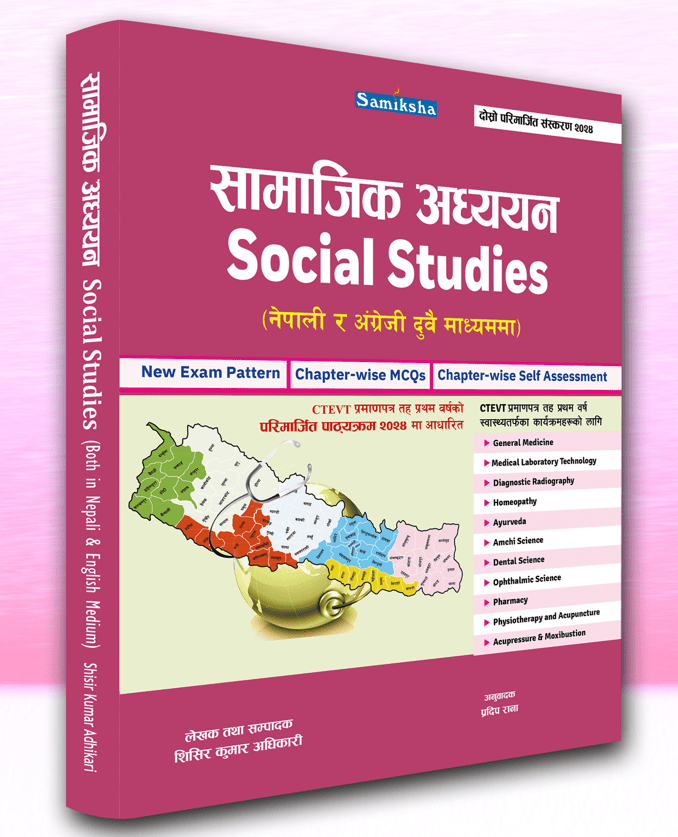
This 'Social Studies' book is primarily based on the revised curriculum for various three-year diploma programs in health sciences conducted by the Council for Technical Education and Vocational Training (CTEVT). These programs include General Medicine, Medical Lab Technology, Diagnostic Radiography, Homeopathy, Ayurveda, Amchi Medicine, Dental Science, Ophthalmic Science, Pharmacy, Physiotherapy, Acupuncture, and Acupressure & Moxibustion. Although it is designed in alignment with these courses, the scope of social studies has broadened over time. In this context, it will be useful for anyone seeking knowledge about Nepal.
Education is continuously made
purposeful, practical, contemporary, and employment-oriented through the
periodic development and revision of curricula and textbooks. With the
significant changes that have recently taken place in the country, the
curriculum has been updated accordingly, and the subject matter in this book
differs from traditional content. As a Nepali citizen, it is essential to have
knowledge about Nepal's geographical conditions, history, and contemporary
social, economic, cultural, and political status. The book covers a range of
multidisciplinary topics such as federalism, governance systems, the new health
structure, revised policies, and the prevailing health challenges in the
country. It is believed that this book will be highly beneficial to both
teachers and students.
It is important to instill in
students a sense of nationhood, national unity, and democratic values while
fostering social and moral qualities such as ethics, discipline, self-reliance,
and creativity. Along with these, the development of basic language and
mathematical skills, as well as fundamental knowledge of science, professional
skills, information and communication technology, environment, and health, is
necessary. Additionally, students should develop an appreciation for art and
beauty, human values, ideals, and a sense of responsibility toward the
conservation and promotion of the country's natural and biological resources.
This book aims to cultivate an inclusive society by fostering respect for
different ethnic groups, genders, disabilities, languages, religions, cultures,
and regions, and by raising awareness about human rights and social values. It
is hoped that this book will contribute to the development of responsible
behavior among students.
Finally, I would like to express
my heartfelt gratitude to all those who have contributed to bringing this book
to its second edition, including professors and students. Special thanks to Mr.
Pradeep Rana Sir and his team for their emotional and dedicated English
translation of the book. I also thank Mr. Tej Prakash Bhandari, Mr. Bhakat
Karki, Mr. Chhatra Prasad Regmi, Mr. Milan Kumar Sharma, Mr. Pradeep Koirala,
and Samiksha Publication Pvt. Ltd., who played a vital role in publishing and
delivering the book to readers. My sincere thanks go to everyone who has
supported this effort, either directly or indirectly. As teachers, students,
parents, intellectuals, and all readers play an important role in further
refining this textbook, I humbly request constructive feedback and suggestions
from all concerned.